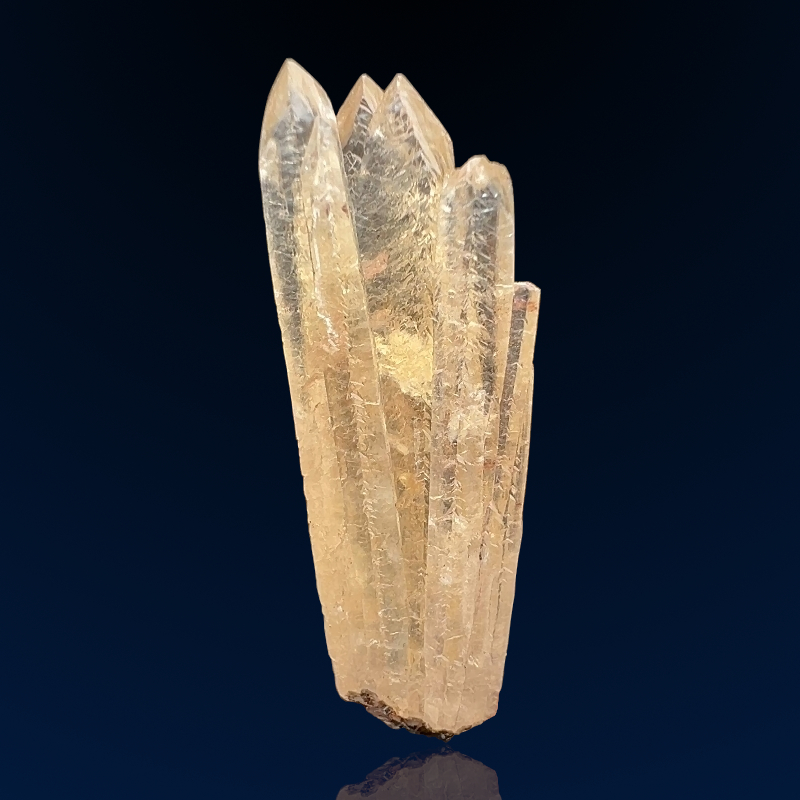
Description
Tsumeb — often described as “the greatest mineral locality on Earth” — and not without reason. This legendary mine has produced an extraordinary variety of minerals, many of which are considered the finest examples of their species. Among these classics is smithsonite, renowned from Tsumeb for its outstanding specimens in an astonishing range of colors and habits. A testament to this is the recent article by Southwood et al. (2025) in Rocks & Minerals (Vol. 100, No. 2), titled “Smithsonite from Tsumeb, Namibia: Color and chemistry”. According to Keller (1977), smithsonite is the most common secondary zinc mineral at Tsumeb and second only to cerussite in overall abundance among the secondary species found there. Although Tsumeb material still frequently appears on the market today, this specimen represents a rather uncommon variety: light yellow, translucent smithsonite crystals with a scalenohedral habit, intergrown to form a lustrous cluster. The pearly sheen of the crystals is truly striking, and under the microscope, a second mineral species of botryoidal habit can be observed attached to their surfaces (likely hematite). An unusual and elegant example of this classic mineral from one of the world’s most historic and prolific localities.
LOCATION
Namibia, Tsumeb
SIZE
2.7 cm
WEIGHT
3 g